This presentation was given on Saturday the 14th of February 2026 at Wollaston Theological College, for the Summer Days unit within the Wollaston Certificate.
Texts:
A few years ago I took an ecotheology unit as part of the Archbishop’s Certificate. It was taught by the Revd Dr Evan Pederick. Evan opened my eyes to the ecological realities of the Bible. More than that, he took our class to places I hadn’t expected, asking big questions.
One big take away was the concept of co-creation. God endowed us in their image: and with this came creative power. We are co-creators with God. And that’s a power we often misuse: so human beings ought to scrutinise their co-creative activity.
If we have this ability to create: that is, to imagine a future that does not exist, things that do not exist, and then act to create them, then surely we must use that co-creative gift in ways which conform with God’s purpose, God’s ultimate vision for the creation: the Kingdom.
Last year we ran a project in the parish of Kalamunda-Lesmurdie last year which has led me to build on this idea.
Tonight I’m going to argue that we should not just be co-creators, but we also co-covenantors.
I’m going to need to think up another name though: that one has already been by a group who represent the sum of all Anglican fears: a movement of angry and well-armed 17th century Scots Presbyterians.
All this started with a Bible verse – one that’s floated around in the parish for a while, and came to take on a particular significance.
Jesus said to them: “I am the bread of life. Whoever comes to me will never be hungry, and whoever believes in me will never be thirsty.” (John 6.35)
And so I arrived at the “Bread of Life Project.” Here are the words of the first poster I made:
“Jesus often taught through short, agricultural stories, and frequently referenced rural life. That’s because Jesus lived among working people, out in the fields of rural Galilee.
We’re going to get our hands dirty, planting wheat and then tending it. When harvest time comes, we’ll cut the wheat, thresh it, separate the wheat from the chaff, and mill the bread to make flour.
Grain to bread to Body.”
Jesus took ordinary things, bread, and wine, essential things, but also things with resonances of satisfaction, joy, and abundance, and instituted the Eucharist, through which he is truly present to us. I wanted to journey in a deep into that wonder – and invite others to do so too.
I sometimes seed ideas around the parish, mentioning them to a few folks, to see what happens. Sometimes, nothing happens – so it goes. But in this case, a parishioner obtained some old Wandoo railway sleepers, and with his children and a friend built a huge raised bed. Another person gave a donation for good soil to fill it.
I was deeply moved by our first gathering.
We had six generations present: from toddlers to great-grandparents. We had crusty old farmers gently helping toddlers as they poked holes into the soil and dropped in each precious grain. One parishioner tried to measure neat lines so the grain would grow in precise rows: meanwhile kids roved around scattering grain everywhere. Chaos and joy.
Just before we planted, we prayed, drawing on the old custom of blessing the plough, and we heard the Parable of the Sower (Luke 8.4-15).
I bought the grain from a local shop. The lovely person in there assured me it would sprout, but I still worried that it wouldn’t! Three weeks later I exhaled, as suddenly we had a fine carpet of tiny green shoots all over the ground.
A month after the planting we gathered to tend the wheat: a word significant in Genesis 2. And we had a beautiful example of the embodied theological exploration I’d hoped for. A young man of the parish said to me “Look Grahame, some of the wheat has grown shallow, and fallen over, just like in the parable!”
And of course Jesus uses that as a metaphor for those who are very keen when they come into faith, but don’t persist, and so wither away.
I came over and looked at the wheat, and said something to the effect of “oh, that’s neat” and thought no more of it.
But ten minutes later, that person was there poking their pinkie finger into the soil beside the fallen plants, gently tucking each one into deeper soil. And so, those plants stood again, and lived.
Isn’t that a beautiful extension of the parable of Jesus? When someone falters in faith, we don’t look on passively like I did: we act, we nurture them, we help them to deeper ground. That parishioner became a co-creator with Jesus, building upon His parable.
It’s time I returned to our two texts, Genesis 1 and 2.
In both these tellings of the creation, God institutes relationship between humanity and the earth.
In Genesis 1, God creates the first humans, and gives them dominion over every living thing that moves on the earth. That’s a kind of delegation. It forms part of the covenant God is forming, the way in which God is ordering relations between the inhabitants of creation.
Too often we forget that God also makes covenant with the beasts of the earth and the birds of the air, and the creeping things as well! They get the green plants for food.
And of course in Genesis 2, there’s a different vision. There’s no plant of the field until after humanity is created. We are formed from the dust in order to do just what we did in the Bread of Life project: to tend and to keep (Genesis 2.15.)
We have these two models for relation between the creation and humanity. And they give us a picture of interrelationship and mutual dependency, but also of obligation, of delegated trust – of covenant.
So let me talk about how it felt as we grew the wheat.
Apart from a couple of retired farmers, none of us had ever grown wheat. And even for the farmers, they hadn’t tried to grow it in a raised planter. We were working far beyond our experience.
And so we ran headlong into various fears.
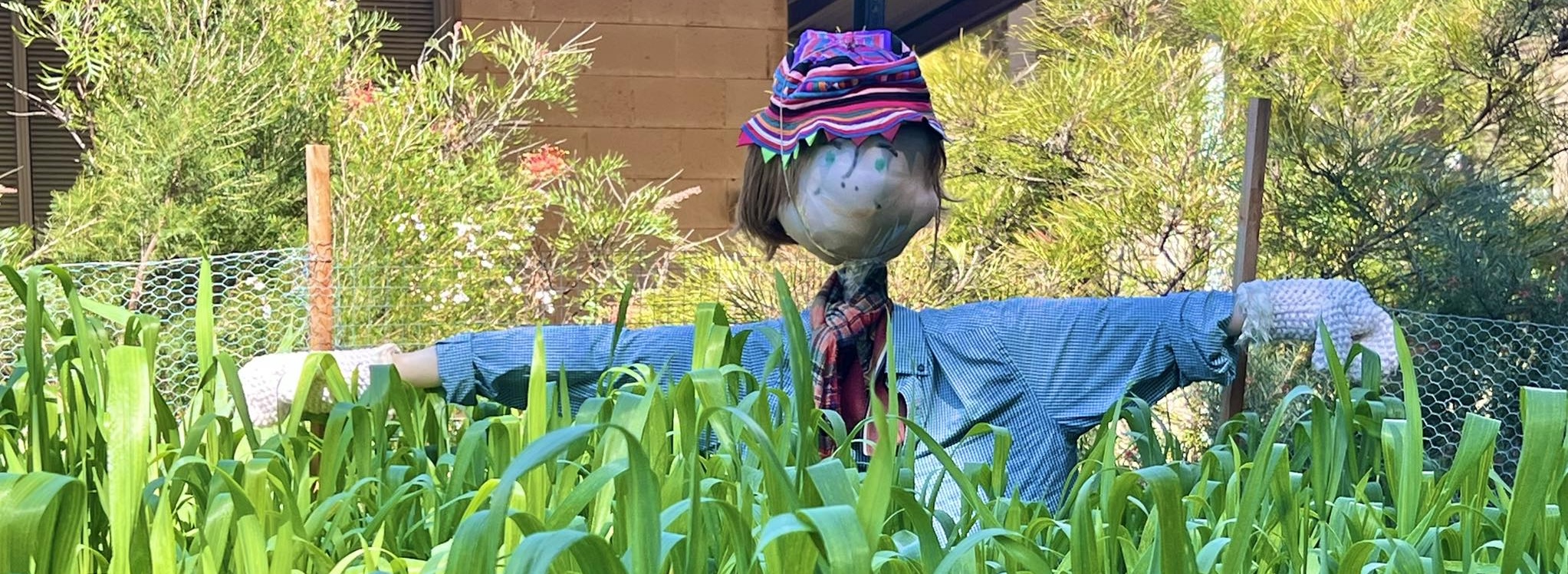
Fear that the wheat would be consumed, either by the creeping things, like snails, or the hopping things, like rabbits, or kangaroos. And so a few weeks in, we found ourselves making a ramshackle fence to go around the wheat, stringing chicken wire around star pickets.
Then came the weather. Initially, the heavy rain of last year was a blessing: the wheat shot up with great gusto. But with height came vulnerability to wind and, ironically, to rain itself. The geometry of nearby buildings made a sort of narrow gully for the wind, so one line of wheat in particular kept falling down.
Often I’d see people gently trying to lift the wheat back into order. Sometimes people I’d never met, just passing by, moved to help.
And then it turned out that wheat will rise again, if given time.
Then all of a sudden the wheat flowered, the flower heads forming seemingly instantly. And with them came an abundance of bees and other insects, and then birds chasing after the bees, and other birds after those birds.
The web of life that is all about us, yet we let go unnoticed, folded itself around the wheat. And we started to do a human thing: we began to tell stories! There was a little furrow of shorter wheat, perhaps where the wind had been channelled through. And with that came an etiology: a legend that a kangaroo had got into the plot and slept there.
I never saw the kangaroo, and perhaps I’m the kind of person to doubt. The shape was certainly there. But also, this new story told of something. The planter had become a place of rest, a place of hospitality.
Seed set on the wheat, and yet the rain continued, and we started to fear that the seed would mildew, or that human passers-by would snick off the grain heads. One person did, at the fete, and narrowly avoided being tackled as a consequence.
And then at the start of Advent, we found ourselves debating at morning teas: is the wheat ready? What a perfect reflection for that season, drawing us to the question of when Jesus will return. Our impatience for the wheat pointed to our impatience for the return of Christ.
Then the wheat turned golden yellow, and we knew that it was time.
We harvested the wheat and bundled it into sheaves, and placed them inside the church sanctuary leaning against the altar to dry. It was meet and right to showcase the sanctity of the crop, and to thank God for the miracle of our daily bread.
About a week later, the spiders hatched. I didn’t see that one coming! There I was presiding at the altar with hundreds of tiny baby spiders clinging to the candlesticks. They seemed to be a species that went with the wheat. I’m sure they ate some weevils that would have imperilled it.
The day before Rejoice Sunday we turned the hall into a threshing floor, and got to work. It all got a bit Book of Ruth, gleaning the wheat by hand. We separated the wheat from the chaff using a huge fan, and then picking through by hand; we milled the flour, and that night I baked the bread.
And in Holy Communion that bread became for us the Bread of Life, the Body of our Saviour.
I can’t share all our learnings. I, for one, am still processing the experience. But I did realise one thing: our dependency on creation is the embodiment of our ultimate dependency upon God.
And with that comes responsibility and trust: God’s trust in us, God’s hope in us. And so follows the need for covenant.
Fifty grams of wheat yielded a harvest of two kilograms: a forty times return.
We take so much from the world, with too little regard for the fellow creatures of our creation. We forget that in the ordering of creation, God makes covenant with them also. That forty times return came from the guardianship of birds, and of spiders. It came from tiny fungi and worms that nurtured the wheat, making minerals and nutrients available.
And some share was gleaned by bronzewing pigeons, and by grasshoppers: by animals who have their own place in the order of creation.
Scholars and theologians wrestle with that word ‘dominion’ in Genesis 1. We do need to wrestle with that word. And I would say that surely as Christians, our dominion must have the character of the Kingdom, the character of the Kingship of Christ.
Jesus came into the world proclaiming and embodying right relationship, the peace that passes all understanding. Kingship that is built upon love, and self-sacrifice.
And so there’s work to be done.
Science continues to cast light upon the interconnected web of life: its strength, its resilience, but also its fragility. And we must to listen to First Nation peoples whose knowledge emerges from their particular, intimate relationship with their land.
Building on that knowledge, knowing what is required, we can forge creative ecological covenants. We can build on what God has instituted, and use the our creative, imaginative capacities to further the flourishing of God’s Kingdom.
Too often we think of the creation in terms of scarcity.
And yet we plant grain, and it grows, and we mill it, and it becomes bread: and at the Eucharist we meet in the elements our Lord.
Reading Genesis 1 and 2 through the lens of the last year, I see a future where we let scarcity-based thinking go, and instead embrace God’s abundance. A future where we revel in the simple wonder of God’s ordering of the world, breaking in as the consequences of sin are redeemed.
I see a future where ecological covenant lies at the heart of the life of the church, of our parishes, our schools, at the heart of everything we do.
It’s time: let’s get ecotheological!