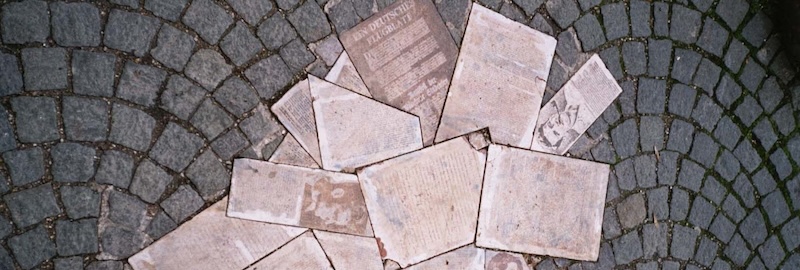
This sermon was preached on the 22nd of February 2026, The First Sunday in Lent, acknowledging the Feast of Sophie Scholl, Hans Scholl, and Christoph Probst.
Texts:
There’s a danger to high places. We should be cautious when we go up to them. And not just because of the practical fear of falling: they are dangerous to us spiritually.
In today’s Gospel, Jesus faces three temptations from the devil. And he faces them after forty days in the wilderness. Take a moment and imagine that. Forty days without food. I remember doing the 48 hour famine as a child, and I found that hard enough, even with a great supply of barley sugars to suck upon.
Jesus was human, flesh and blood, just as we are. After those forty days He would have been weakened, even emaciated, perhaps at the brink of death. And so would you think that physical temptation – the draw of food for a famished mouth – would have been the greatest temptation that the devil could muster.
And yet it was not so. The devil started there, and then rapidly escalated when Jesus passed the test. The next two temptations involve high places, places above, places of worldly power. This is the greater temptation, subtler, and more insidious.
First Jesus is taken and placed upon the pinnacle of the great temple in Jerusalem. According to Josephus, the ancient Jewish historian, the fall from that place into the Kidron Valley would have been nearly a hundred and forty metres. That’s pretty much exactly the height of the tall building in the square beside St George’s Cathedral.
The devil knows who Jesus is. And so the temptation for Jesus is to flaunt his Divine identity, to make ostentatious use of it in his own service, leaping down from the temple into the busy square, his fall arrested by the beating wings of angels.
Again, Jesus resists: and so the devil takes him to an even higher place, up to a very high mountain, a place so high that all humanity, all our hopes and endeavours, appeared only like a thin layer on the sphere of the world. And then the devil offers dominion to Jesus, if only Jesus will serve him.
There is no greater temptation than this, and so when Jesus overcomes it, the devil departs, defeated.
How do we respond to this now, today? How do we ward ourselves from the spiritual dangers of high places, the spiritual dangers of desiring or possessing power and authority?
Today is the 22nd of February. Eighty-three years ago, on this day in 1943, three Christian students were executed in Munich by the Nazi regime.
Their names were Christoph Probst, aged 23; Hans Scholl, aged 24; and Sophie Scholl, aged 21. They were activists at the University of Munich, key members of the non-violent White Rose movement.
The awful truth is that many in the churches of Germany were complicit with the Nazi regime: complicit with a regime which waged wars and conducted genocide, ending millions of precious lives. Some Christians dared to use the teachings of the Bible to endorse these actions, discarding the Old Testament as Jewish, and distorting and profaning the New Testament.
Those people chose power, and they chose their own vain glory. They chose their own ends over and above the Kingdom of God. Thinking of those people, and their misuse of Scripture to further evil ends, my mind turns to the devil, who quotes from that same Scripture in order to tempt Jesus.
Many, perhaps most of the leaders of the church in Germany sought simply to survive, to ride out the storm so that they might avoid imprisonment or death. They sought to cope with, to work within, an evil system, they looked to preserve their own social position. And so they too – in a more passive, less obvious way – fell prey to the second and third temptations that Jesus faced.
But some brave Christians, guided by the Spirit, kept the faith, and by Grace dared to face the cost of discipleship.
Six pamphlets were released by the White Rose movement. You can read them, translated into English, if you visit the Society of the White Rose website.
These were young people: they spoke boldly and with passion. They didn’t hold their tongues as the foolish wise might have done. They named the evil that they saw going on around them, and they called upon their fellow people to rise up and resist.
And they were Christian. They read from the Bible, they read from the tradition of the Church. They were influenced by the Confessions of Saint Augustine, and by the sermons of the great Anglican and Catholic saint, John Henry Newman.
A letter of the movement quoted from Newman’s sermon titled ‘The Testimony of Conscience’:
“[W]e know by whom we are created, and that we stand in a relationship of moral obligation to our creator. Conscience gives us the capacity to distinguish between good and evil.”
Conscience gives us the capacity to distinguish between good and evil.
And so, on the 18th of February 1943, Sophie Scholl and her brother Hans smuggled the sixth pamphlet of the White Rose into the Ludwig Maximilian University of Munich, concealed within a piece of luggage.
This was a major university that operated from a large building: floor after floor of tutorial rooms and lecture halls climbing up around a central atrium. They left copies of their leaflets where students and staff would find them, making their way higher and higher up the building as they went, ascending to the top.
And when Sophie was there, on the top balcony above the atrium, she found that she had some pamphlets left over. And so, spontaneously, perhaps moved by the Spirit, she threw them down from that high place and into the atrium of the main university building.
Picture those white leaflets fluttering, bearing their testimony against evil down through the air, down to those sleep-walking people, who turned their eyes upwards and were suddenly awakened. I imagine it was as if time stopped for a moment.
Sophie and Hans were immediately arrested by the Gestapo. A few days later they were executed by guillotine, alongside Christoph, after a sham trial.
And yet their testimony, their witness, could not be suppressed. Their story rippled through Munich, the hub of the Nazi regime. And that sixth leaflet was smuggled out and reprinted in great numbers in Britain, and then dropped across Germany by the Royal Air Force.
Their story could never be suppressed because it was God’s story. The story of God, the Truth, cannot be suppressed.
I pray that we will never such times as they saw.
Guided by providence, Sophie Scholl showed us how Christians can occupy those dangerous high places. She went ascended not to serve herself, but to serve others, to serve God.
There are two accounts of her last words: she said either “God, my refuge into eternity”; or she said “The sun still shines.”
Both are a prayer. A prayer! Her words remind me of the great words of Saint John – “The light shines in the darkness, and the darkness shall never overcome it.”
We are in the season of Lent: a season when we open ourselves to reflection, to penitence, to Truth. And the truth is that we all of us face the three temptations that Jesus faced. Temptations of the body, temptations of worldly desires, of spiritual and political power.
Every Christian is called to take upon themselves the mantle of Jesus. And that is why every Christian generation remembers, and is encouraged by the witness of those saints who have gone before them – those brave souls who dared to follow the Living Lord, perhaps with fear and trepidation, but empowered by a far greater hope.
Be encouraged by Sophie, and Hans, and Christoph.
Turn away from yourself, and turn to God.
Look not to your own glory, but rather to the glory of God. Uphold the dignity of every human person, as God upholds that dignity. Dare to be holy, trusting in God, your refuge into eternity.
The Lord be with you.