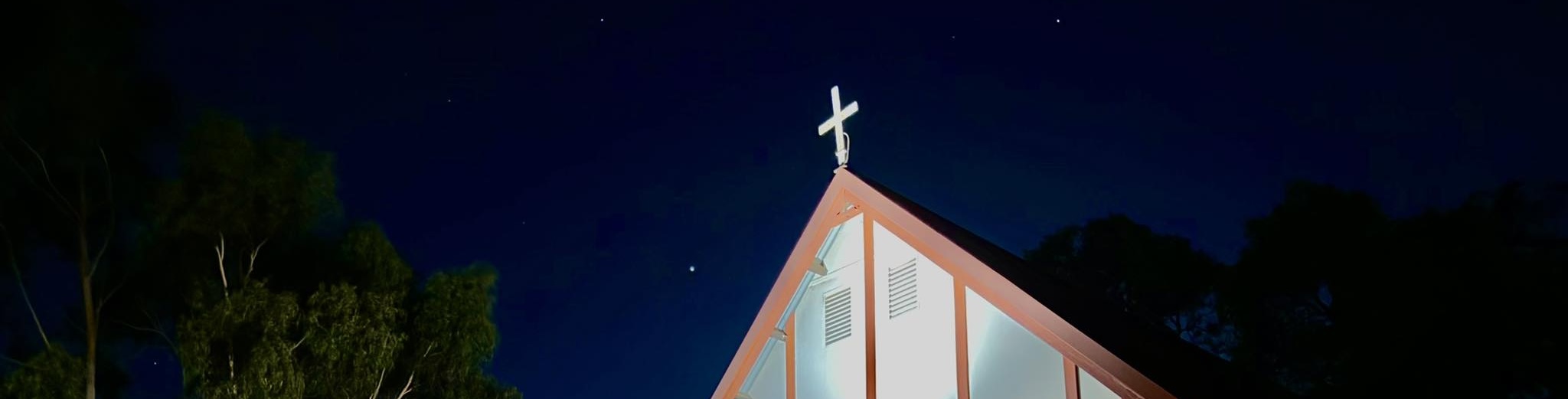
This sermon was preached on the 8th of February 2026, The Fifth Sunday after Epiphany, at St Barnabas Church, Kalamunda.
Sometimes preaching week, after week, after week is a tricky thing. Sometimes I get tangled up while preparing to preach. I can’t settle down, I can’t find a clear single clear message to take from the text. And today is one of those days: we have the magnificent words of Isaiah, Saint Paul at his best, the deep and multi-faceted teachings of Jesus.
And so yesterday I found myself bursting into the Coles across the road from the church here in Kalamunda, seeking after a pomegranate. I was hoping to find one as a prop for this sermon, so that I could bring to life a particular teaching of Jesus in today’s Gospel.
Jesus says that not one letter, not one yod, not one mark, one iota, of the law will pass from the law.
And in Jewish thought, a pomegranate is a symbol of that same law. Since the time of Maimonides, a 12th century Rabbi, there’s been an understanding that there are 613 commandments in the Torah: 248 positive exhortations, and 365 admonishments not to do particular things.
But… Coles didn’t have any pomegranates, despite what their app said.
So I found myself back at home, sitting at my desk, mildly defeated: and then I remembered something a wise priest once said to me. Each week we have a Collect Prayer, a prayer led by the priest which gathers us together into a shared intention. And that can give us a way into the readings.
This week, our intention is that we might not hide the great hope, the light of Christ, which has been given to us. Instead, we ask for God’s help in telling everyone of the love we have met in Jesus.
And so I find myself wondering: why might we hide the light of Jesus? What might stop us from being the light upon the hill, the living proclamation that Jesus urges us to be?
Wrestling with that issue, I found myself settling on a single verse:
“People do not light a lamp and put it under the bushel basket; rather, they put it on the lampstand and it gives light to all in the house.” (Mt 5.15)
And rolling this verse back and forth in my mind, I found myself drawn to be very literal about it.
Like many Australians, I live in a fairly large house. It has twelve different rooms – I counted them yesterday – bedrooms, bathrooms, the kitchen, the lounge, the living room, and so on and so on.
But the people who Jesus originally taught through the words of today’s Gospel lived in houses of a single room. What living spaces there were for each person surrounded a central, shared area.
Hang up a single lamp in that central area, and there is light for all.
Hang up a single lamp in just one of the rooms of my house, and it’s inevitable that I’m going to pretty badly stub my toe trying to get to bed at the end of the day. Or trip over one of my two dear cats.
And so this rather literal exercise brings us back to the question I posed: what is it that can draw us to hide the light of Christ?
Well, surely the fact that I live in this great big house, and have all these things, and live in a world of endless possibilities for entertainment and distraction, surely that makes it a bit harder to focus on what is truly important.
And so I might find that I’ve left the light of Christ, the precious hope that has been given to me, in the spare bedroom that I rarely go into.
“Vanity of vanities, says the Teacher, vanity of vanities! All is vanity.” (Eccl 1.1)
So begins the book of Ecclesiastes, the teachings of Kohelet, a book very much for our time.
We are surrounded by so much that feels urgent, and important, even vital. And yet, much of it, in the end, is mere vanity. And so we are called to discern. Discernment lies at the heart of the Christian life.
In today’s Gospel, Jesus encourages us in good works, that our light might shine before others, and bring others to give glory to God the Father. And at times Christians can get tangled up about works. Good works never involve vanity. They are not about self-justification: they are not about earning favour with God, or with our fellow people. Rather, good works are an outworking that that emerges when we follow Jesus, and embody his teaching.
And so we return to discernment: about how we are to live, how we are to answer the call of Jesus, what we should take up, and what we must set aside. But this is a difficult thing to sustain: particularly for us modern people, immersed as we are in a sea of distraction.
To echo once more the pattern of Ecclesiastes, there is a season and a time for discernment, a time when we remember what is truly vital, what is truly essential.
We are on the cusp of Lent: it begins in just over a week. And Lent is a penitential season. Forty days in the wilderness which echo the forty days that Jesus spent fasting, and enduring temptation from the .
That word, penitential, can be a stumbling block.
It sounds like we are to spend forty days wallowing in an understanding of our own wretchedness. And we might well react against such an idea. Indeed, I would argue that this would be just another form of vanity.
So instead, I urge you to take Lent seriously because we are all of us, each and every day of our lives, in a wilderness not of emptiness, but of busy-ness, temptation, and distraction.
A wilderness which constantly threatens to draw us away from that which matters.
And so Lent does involve sacrifice: not sacrifice of self-punishment, but a giving up of that which does not matter. A giving up of our vanity, of our wish to fulfil our every desire.
Remember the hope that Jesus has given us.
Put it at the centre of your life. I used my house as a metaphor: the fact that a single light in my house could not reach every room. Well, we pare back, so that the light can permeate every aspect of our lives.
Over these final few days before lent, I encourage you to spend time in prayer. Maybe discuss how you will approach Lent with family, or friends. And of course, I’m happy to talk with you. Or keep it private: whatever you are comfortable with.
But ask yourself: where is the distraction, and where is the vanity?
Every person in this room, every person who is, has ever been, and ever will be, is made in the image and likeness of God.
Each of us is infinitely precious in God’s sight.
And that is why Jesus, the very Son of God, God embodied, God incarnate, came into the world to be with us. Because are we are alike to stray sheep, and He is the shepherd who loves us, asking nothing, nothing in return, but always calling us by name, calling us by who He knows we are to be, who we are in our innermost selves.
Hear that call for a season. Set aside distraction. Turn away from noise and tumult, turn away from vanity. Simply listen.
Be still and know your God.
The Lord be with you.