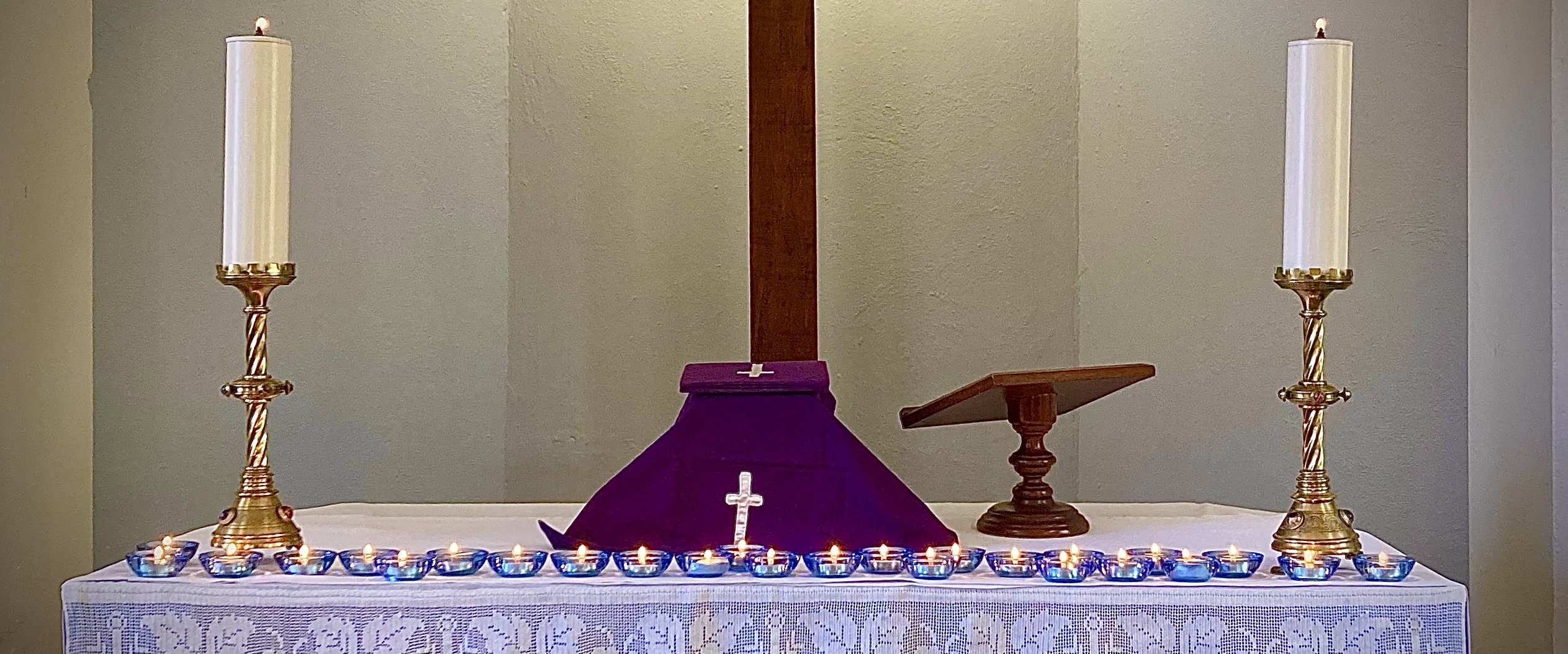
This sermon was preached on the 21st of December 2025, the Fourth Sunday of Advent, in the Anglican Parish of Kalamunda-Lesmurdie.
Texts:
What do we do when the unexpected breaks into our lives? What do we do when we find ourselves reeling, wondering what is happening, wondering what is coming?
This Advent, I’ve encouraged you all to slow things down, as much as you are able. To let go of that which draws you to be busy, hurried, chaotic… and simply be still, and be with God.
And then the events of Sunday night happened – and, at least for me, that went out the window. On Sunday evening I opened up the news on my phone, and was transfixed with horror at the attacks on Bondi beach. Attacks against Jewish people, attacks against our fellow Australians, our fellow human beings, as they gathered to pray.
The actions of those two men, the attackers, were profane. It is profane, it is an profound offence to God to murder – to murder innocent people gathered in prayer. And I find myself stunned that a father and a son could do that together. That, also, is profane.
And witnessing, at a distance, to that profanity, I found myself afraid. Sitting with that fear, I realised I was afraid that the gunmen might succeed.
I was afraid because the profanity of their attack was very much intended. They sought not only – as if that wasn’t enough of an offence – to end innocent lives, but to attack the threads that hold the people of this place together.
To cut the cords of our society. To turn us against one another, to reduce us to a jumble of labels, a jumble of labels and categories locked in conflict.
Sitting down that night to say evening prayer, the appointed Psalm seemed almost cruelly prescient:
O God, the heathen have come into your land:
they have defiled your holy temple,
they have made Jerusalem a heap of stones…
Their blood they have spilt like water
on every side of Jerusalem
(Psalm 79.1,3a)
And then I think of today’s Psalm:
Restore us again, O Lord of hosts:
show us the light of your countenance,
and we shall be saved.
Show us the light of your countenance, and we shall be saved!
We have seen that light, the light of God, this week in Australia. We saw it in Boris and Sofia Gurman, Russian-Jewish Australians, who died trying to stop the attack, when they saw the gunmen leaving their car, carrying rifles.
We saw it in Ahmed al-Ahmed, a Syrian-Islamic Australian, who saw what was happening, turned to his cousin and asked him to tell his family why he was acting, and then disarmed one of the attackers, being shot five times as a consequence. Ahmed chose not to use the gun he had taken from the attacker. He chose life, not retribution. Surely, that is profound.
We saw the countenance of God in the police who did their duty and risked their lives to intervene; in those who sheltered children with their bodies; in thousands of acts of care and love that will go unreported and unknown, which will pass without public acclaim.
We saw the countenance of God, and the solidarity of Australians with the Jewish people, when more than fifty thousand Australians responded to the atrocity at Bondi by giving blood.
Starting this sermon, I raised the difficulty of the unknown. In today’s Gospel, we hear of Saint Joseph faced with an unknown: an unknown which seems poised to derail the life he had anticipated having with Mary. And then Joseph learns that he is amidst the plan of God. That God is to come among us, embodied, Emmanuel, God with us. And so he realises that he is, himself, a part of a story so much greater than himself.
I’m not going to pretend that what happened at Bondi was part of the story of God, that it was the plan of God. God does not desire that anyone should die, God does not desire violence.
But we must remember that we are part of the story of God, we are part of the unfolding of the Kingdom, we are, like Joseph, part of a story that is so much greater than ourselves.
And so, I urge you all, do whatever you can to thwart those attackers.
They desire that you hate. Instead, love, and love abundantly.
They desire that the bonds between the people of our nation should be broken. Instead, know your neighbour, love your neighbour.
They desire that you should make God smaller than God is, that you should reduce your understanding of God to something narrow, and sectarian. They desire that you should reduce God to a pallid reflection of yourself, a mere affirmation of your own righteousness. That is, after all, what those who commit religious violence do themselves. That is the core of their sin, the essence of their profanity.
Instead, be still, and know your God, our God, the one true God.
Know that God desires that every person should live. Know that God is drawing us all to Godself. Know that God calls you to love God, and to love your neighbour as yourself. The two great commandments of Jesus are intertwined and inseparable.
Upon the Cross, Jesus took upon himself the sum of all human hatred, the sum of all human violence, the sum of all that we do to one another and to God. And to all this, God replied with life – life eternal.
And so, remember the Cross. Remember the Sacred Heart of Jesus. Love God, and love your neighbour.
The light shines in the darkness, and the darkness shall never overcome it.